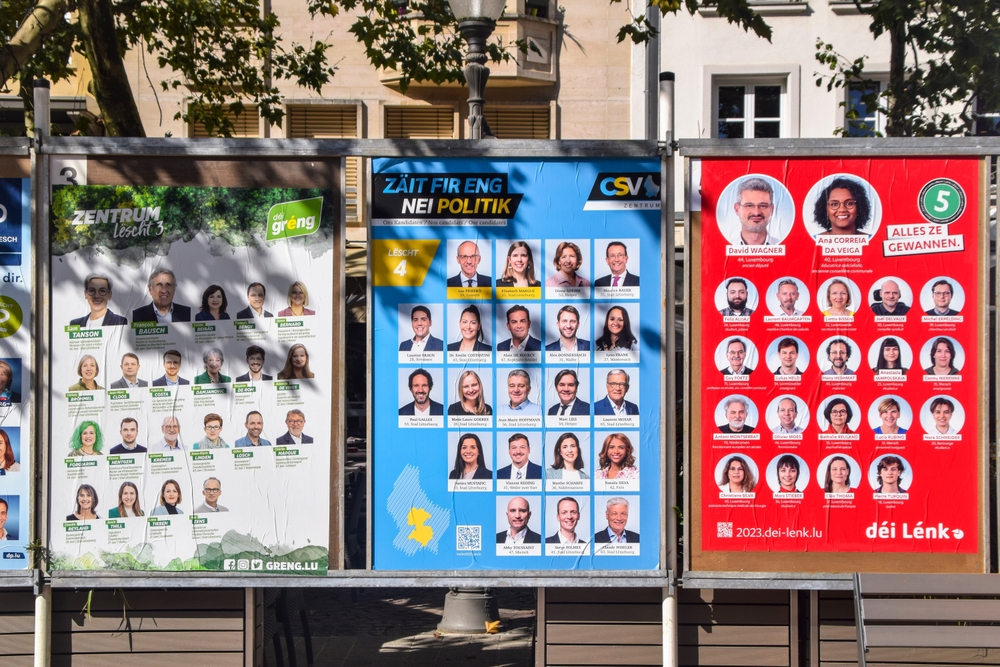

For the first time since 2004, it looks like the Luxembourg Socialist Workers’ Party (LSAP) will not be a part of the Luxembourgish government. Still, the LSAP remains strong and is more important than ever in a context where the political landscape seems to be tilting to the right.
The LSAP has played a determining role in fashioning the country’s fate in the past decades. Indeed, since 1984, the LSAP has been in government as a coalition partner except for one legislative period. Two-party coalition governments of Christian Democrats, Socialists and Liberals in various constellations have long dominated Luxembourg’s political landscape. In 2013, Socialists, Greens and Liberals came together under a progressive agenda to break with this tradition. This coalition retained its majority in the 2018 elections to govern for another five years. The principal question surrounding this year’s elections was the following: would the current three-party coalition government of LSAP, Liberals and Greens gather enough votes to maintain the current coalition or would the Christian Democrats, led by former finance minister Luc Frieden, responsible for Luxembourg’s austerity politics during the financial crisis, return to government with one or more partners?
The election campaign was short and focussed mainly on issues like the tax system, affordable housing, the health system, and the preservation of purchasing power. The Luxembourgish Socialist Workers’ Party (LSAP) have run a good campaign under the leadership of our lead candidate, Paulette Lenert, the current vice prime minister. She rose to fame as a health minister who skilfully managed the Covid-19 pandemic and, contrary to many other health ministers in other member states, became one of the most popular politicians in the country. The LSAP ran on a platform of social justice, advocating inter alia for a fairer tax system, under which those with lower incomes are unburdened and those with higher incomes would have to contribute more, educational equity, the need to ensure that the climate and digital transitions are just and a reduction of working time.
We have received strong public support, coming in second in the popular vote (18,91 per cent), in front of current Prime Minister Xavier Bettel’s Liberal Party (18,7 per cent). Unfortunately, due to our electoral system, the LSAP has only gained one additional seat for a total of 11, while the Liberals have won 2 additional seats for a total of 14. The Christian Democrats remain the strongest party by quite a margin, keeping their 21 seats, while the Greens have collapsed and lost more than half of their seats, going from 9 to 4. This result means the current governing coalition no longer has a majority and will not return for a third mandate. The Christian Democrats have now been tasked to form a government. While the LSAP is theoretically also an option, the Christian Democrats have now started coalition talks with the Liberals, as they see them as a better programmatic fit and give them a stronger majority. This means that the LSAP, despite its good result, will likely no longer be part of a government. However, a strong Socialist perspective will be more important than ever.
The election results indicate a somewhat worrying shift towards the right. Even though the LSAP is strengthened, the massive losses of the Greens and the modest result of the Leftist party leave the progressive camp weakened to the detriment of the more liberal and conservative forces in the country. While any future government will remain staunchly pro-European, a possible coalition between Christian Democrats and Liberals could spell more stringency on budget and less flexibility on fiscal matters, a closer relationship with the business community, and a different approach to climate and migration issues. The populist right party (ADR) has equally made gains, though they have ultimately remained more modest than initially feared. Still, while they were historically more timid than populist parties on the right from abroad, we have now witnessed a radicalisation of their discourse during the election campaign, mirroring some of their sister parties from larger member states.
That being said, an argument can be made that their increased support can be linked to their strong focus on the question of growth and its negative consequences, inter alia an unmatched need for new infrastructure due to population growth, and increasingly acute challenges regarding mobility and housing, which affect the population in a very direct way. While the established parties have mainly skirted the growth issue, the ADR’s clear discourse offering simplistic solutions seems to have struck a chord with the electorate. In this political landscape, it will be crucial to have a strong LSAP that continues to defend fundamental values, be ambitious regarding climate change, and be relentless about calling for more social justice and combatting inequalities. We will continue this fight in Luxembourg and Europe.
Photo credits: Shutterstock/NGCHIYUI