
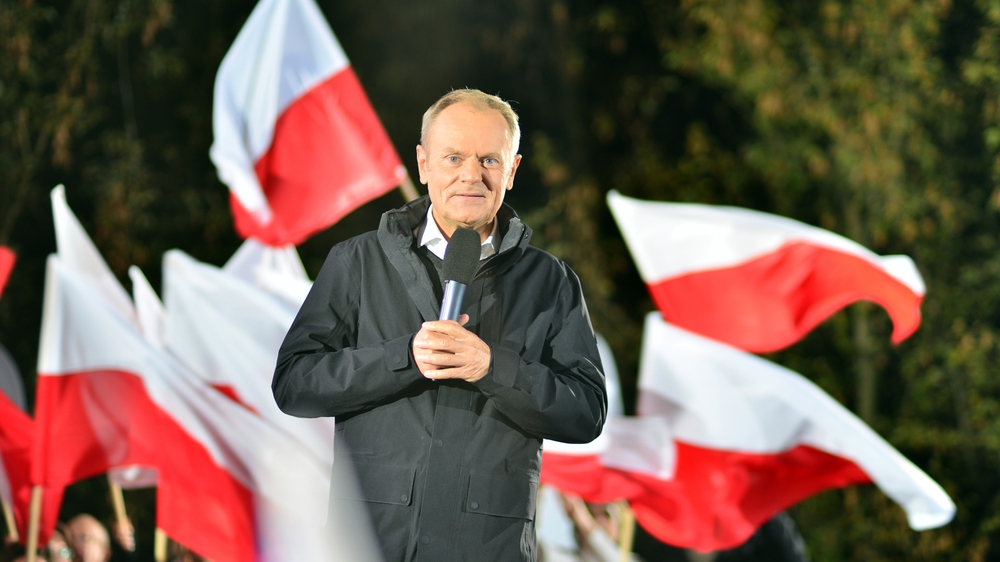

Poland’s autumn elections resulted in a collective win for the current opposition parties, even though the populist Law and Justice party (PiS) remains the strongest party in Poland. In the coming weeks, a final coalition agreement among the parties of the future government majority will be forged. Meanwhile, there will also be attempts by those currently in power to democratically reverse the election verdict through behind-the-scenes actions and efforts to break up the unity of the democratic opposition.
The 15 October parliamentary elections in Poland brought a change in the balance of power in parliament. The tenth legislative term of the Sejm will be dominated by the incumbent opposition parties, with a slight advantage for the rather liberal and conservative centrist ones. The ruling populist party has received fewer votes than in previous elections, nevertheless, its result is still impressive, and the party still has the social base to return to power in the future.
One of the key factors that led to the democratic opposition – Civic Coalition, KO (EPP), Third Way, 3D, (RE/EPP), Left (S&D) winning a majority of 248 out of 460 seats in parliament – was the record voter turnout. The scale of citizen mobilisation was even greater than in 1989, when the first partially free elections were held and decided to remove the communists from power after 44 years of de facto dictatorship and dependence on the USSR. Nearly 75 per cent of Poles took part in the elections. This turnout, compared with the average one of the past 30 years, which was a little over 50 per cent, is a sign of the impressive turnaround in civic attitudes that has taken place in recent years. Several reasons can explain this great democratic upsurge in Polish society: first, the disagreement with the continuation of populist rule among the, mostly liberal-progressive, part of society; second, the facilitations and incentives for voters that the populist government has introduced (such as, e-services, increasing the number of polling stations, providing free transportation to polling stations). The ruling Law and Justice party was guided by the assumption that such measures to make it easier for citizens to vote would work in their favour, but it turned out that, paradoxically, they helped the opposition more.
Analysing the elections in absolute numbers, that is, considering the number of votes cast for each grouping, it is possible to indicate the directions of change and give a preliminary diagnosis of the result.
The Law and Justice party (ECR) obtained 7.6 million votes and lost about 0.4 million votes. This loss corresponds to the estimated impact of changes in the demographic structure as a result of the Covid-19 pandemic. However, in-depth analyses show that, in total, PiS lost about 2 million voters from previous elections, but convinced and mobilised about 1.5 million new ones. Most of its voters voted for social security and against non-European migration, that is, for the continuation of current policies.
The Civic Coalition (EPP) received 6.6 million votes, 1.5 million more than four years earlier. This should be attributed to two factors: the mobilisation of the reserves of the opposition electorate, and the attraction of the liberal-progressive voters of the Left in 2019.
Third Way (RE/EPP) received 3.1 million votes. No straightforward comparison to previous election cycles is possible here, but given the result of the PSL – one of the two parties that make up this grouping – it can be assumed that the Third Way became the main choice for newly mobilised opposition voters who had not previously voted (mainly from the 30-50 age cohorts).
The Left (S&D) gained 1.8 million votes and counted a loss of nearly 500,000 voters, who have shifted to other parties, mainly the Civic Coalition. The driving force behind this shift may have been a misalignment of issues in the campaign, where the social agenda was heavily emphasised at the expense of the progressive agenda (reproductive rights, sexual ethics), which was partially taken over by the stronger liberal competition. It should be added that eight years of PiS rule significantly reduced the demand for social agenda among opposition voters, and a barrier to the takeover of social voters voting for the incumbent government was their rather conservative profile.
The Confederation (NI) obtained 1.5 million votes, 300,000 more votes than four years ago. An alt-right grouping that can confidently say that, despite the better result, their campaign was a failure. The economically liberal and morally extreme conservative Confederates failed to meet the public’s emotions and expectations. The grouping deliberately failed to take advantage of the opportunity to extend the liberal doctrine into the area of moral issues, which was, from the point of view of their interests, a basic condition for a better (and achievable) electoral result.
These latter two parties (along with PiS, which is losing power) are among the clear losers of this election campaign. For the Left and the Confederation, an important element of their unsatisfactory electoral outcome was the high turnout and the growing numerical disproportion between young voters, who constitute the main base of these groups, and the older generations, who tend to choose more often centrist or populist parties.
The coming weeks will be spent shaping the new parliamentary and governmental majority, which, according to pre-election promises is to be formed by the Civic Coalition, the Third Way and the Left. Due to the poor performance of the Left, its share in the next cabinet will be smaller and its influence limited. The coalition will be dominated by liberal-economic and at the same time rather much less progressive KO and 3D. This means that the social agenda will be clearly limited, and progressive elements such as reproductive rights or marriage equality will not be subject to change in the current parliament.
It should also be kept in mind that taking over the government and implementing election promises will be difficult for the new majority, due to the fact that the former ruling Law and Justice party will retain considerable influence on state institutions, among others over the central bank, the constitutional court and the president, who was elected as the party’s candidate.
Photo credits: Shutterstock.com/Grand Warszawski