

With the initial exit polls of the Polish parliamentary elections reaching the public at home and abroad, many took to social media to speak about the ‘return of democracy’. However, in the aftermath of 15 October, anyone seeing the seat distribution should refrain from pairing the noun ‘democracy’ with the adjectives ‘social’ or ‘young’.
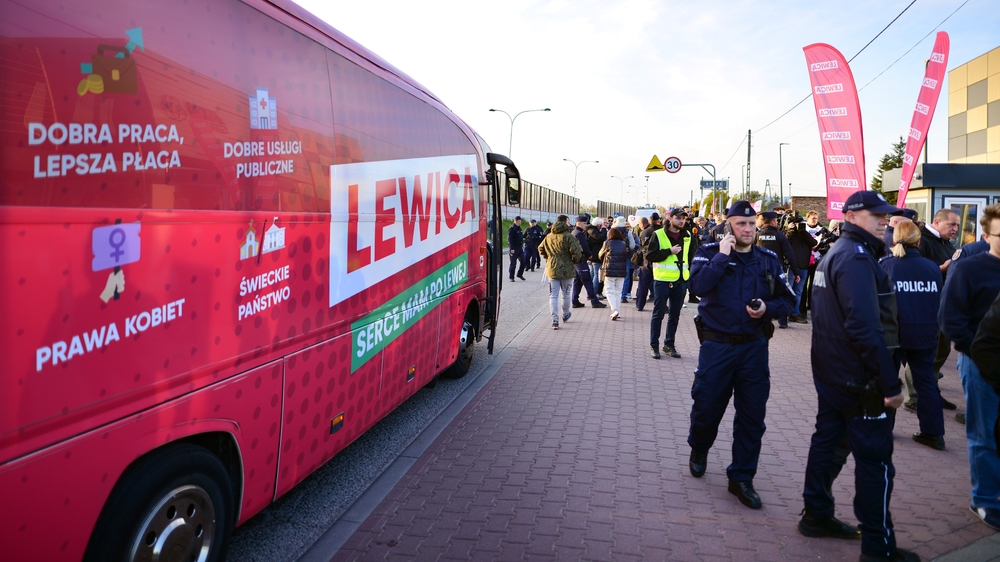
With 100 per cent of votes counted, the historic turnout of 74.38 per cent did not prevent the Left Coalition from falling to 26 seats in the Sejm, setting the score of any formation (co)-led by the former Democratic Left Alliance at a historic low. The national score of 8.6 per cent has sent trembles through the New Left’s factions, SLD and Wiosna. By its leaders, however, it is being presented as a crucial component of the victory against Law and Justice (PiS), and as a certainty of entering the government as the third, controlling and socially oriented force. The Left Coalition had hoped for a two-digit score, which was its stable polling in the months leading up to the elections. Combined with the euphoric memory of coming back to the Parliament (49 MPs in 2019), the result has not only left the party members gutted, but its leadership seems stuck in the mentality of hoping to be more than a drop in the ocean in a possible governmental coalition. Such a coalition would be controlled by the centre-right, which has been bringing more empty slogans than meaningful programmatic proposals to the table. This situation calls for a deep reflection on whether entering the government at the mercy of Donald Tusk is in any way justifiable as a victory. Some of the Nowa Lewica leadership’s seats were barely won, with others not even approaching the real entry threshold.
Despite the many answers to the question of where it went wrong for the Left (but not for the opposition), one of the crucial ones seems to be the lack of any attempt at broadening the electoral base. With rather satisfactory results in bigger cities and in the long-established bastions of the Left, such as the post-industrial Silesia, no attempt by the central leadership was made at picking up a fight in the East of Poland. And this is not only true for The Left, but most of the other opposition parties that perceived anything east of Warsaw as PiS bastions. Surely, taking up such a fight would require an adaptation of rhetoric, with the process needing to start much earlier than when parties remember that someone needs to elect them first for them to mean anything. Nonetheless, this is where seats could have been won, when talking of the ‘socially’ oriented electorate. All in all, the Left has been repeatedly claiming that there can be no democracy without its social face, and using that argument when answering the question of what truly distinguishes The Left in the broader landscape of the opposition.
What contributed to the score of The Left Coalition, besides the geographical distribution – or lack thereof – was, it seems, the inability of The Left Coalition to come up with an innovative way to either retain, or attract, the votes of the youth and women. Despite being truly the first ones to fight for the liberalisation of the abortion laws (supported by almost 60 per cent of the electorate), the Left has only managed to score 10 per cent of women’s votes (according to Ipsos latest poll), as parties of a catch-all nature started adopting leftist rhetoric, even if purely for electoral purposes. All this made The Left’s and the Left-leaning electorate drift away to parties doing ‘safer’ in the polls and with almost only an anti-PiS message, such as the Civic Coalition. The examples of such a dynamic are many, underlining even further how The Left failed to create a public perception of being the true initiator of progressive legislation. Another example could be the New Left’s mobilisation around the re-evaluation of the pension schemes, which could be seen as an attempt to reach out to the electorate associated with Law and Justice. However, The Left did not manage to score more than 5.2 per cent in the 60+ age group.
With the local and European elections approaching in fast, the performance of The Left Coalition should serve as a wake-up call, not only for creating an attractive campaign strategy that could work for all members of the coalition, differing according to the ‘needs’ of the districts, but also for understanding that the foundations of the electoral battle are the electoral lists. With the turn-out of the 18-29 age group amounting to almost 70 per cent, which is credited as one of the main reasons for removing Law and Justice from power, the new Sejm, as of now, has only three out of 460 MPs under 30, with none of them from The Left. The record-high turnout of young voters is clear evidence of the Polish youth’s political engagement. It would only be fair that younger, newer faces are trusted and allowed to represent this huge chunk of the electorate that grew up during the lockdown, the abortion law protests, or spending nights volunteering at the closest train station helping refugees from Ukraine. Because younger does not necessarily mean inexperienced.
Photo credits: Shutterstock.com/Grand Warszawawski