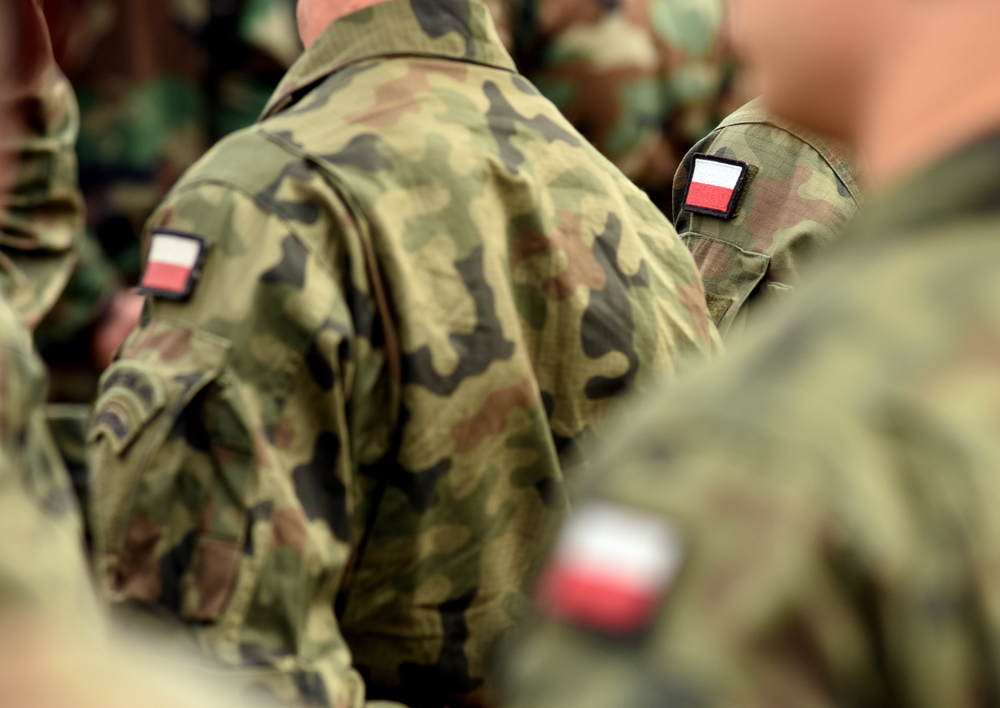

During the eight years of the Law and Justice (PiS) government, the Polish Army has been subject to constant politicisation. The effects became particularly manifest during the recent parliamentary election campaign, “blurring the line between party and State, contrary to OSCE commitments, as observed by the ODIHR/OSCE in their preliminary post-election report from Poland.
A while before the last parliamentary elections, a short video from Australia gained great popularity on social media in Poland. During a press conference in 2019, held by Australian Defence Minister Christopher Pyne, the Chief of the General Staff, General Angus Campbell approached the minister as he was speaking and asked to release a group of senior commanders, accompanying the minister, as he had just started responding to political issues. The minister immediately agreed to the general’s request by allowing the military to step aside during the ongoing press conference. This scene, a template of civil-military relationship in the public sphere, was presented by Polish internet users as the antithesis of the practice introduced during the rule of Law and Justice in Poland.
In fact, since PiS took power in 2015, the military has ceased to be an area excluded from party agitation. The political methods of PiS – such as inciting extreme polarisation by demonising opponents – have also found their everyday application by the two successive ministers of defence. In that respect, practices in the army did not differ much from other areas of the Polish state, just to name the judicial system and in particular the Constitutional Tribunal, the prosecutor’s office, state-owned companies, all state funds and agencies.
The election campaign that has just finished turned out to be the culmination of Law and Justice’s efforts to utilise the image of the Polish Army and its soldiers for the purposes of political means. There was not a day without a press conference of the Minister of National Defence against the background of soldiers and equipment in military units. The minister’s statements were always of an extremely electoral nature. A constant rhetorical element was comparing the alleged omissions of Donald Tusk’s government with the alleged unique successes of the PiS government.
But the rhetoric went much further; the minister directly accused opposition politicians and the highest army commanders of the past of treason. For this purpose – an unprecedented thing – he declassified and published a fragment of one of the operational plans of the Polish Army and NATO, which assumed the possibility of stopping a possible Russian attack only at the Vistula line. This fragment of the text became a permanent element of PiS campaigning, accusing political rivals of betrayal and lack of will to defend a significant part of Poland, which would enable the Russians to commit crimes in Polish cities “like in Bucha”. Against this background, PiS presented itself as true patriots who, unlike their predecessors, would truly defend Poland.
The rhetoric in other areas of defence policy was similar: Donald Tusk disarmed the Polish army – PiS buys the best weapons from the US for billions of dollars; Tusk liquidated units in eastern Poland, preparing a second Bucha – PiS re-establishes these military units; Tusk reduced the size of the army – PiS is building a 300,000 soldiers army, which will be the strongest in Europe. This was the everyday narrative of the Minister of National Defence at press conferences held on the background of Polish military personnel.
Subordinating the army to the logic of PiS (‘whoever is not with us is against us’) has been a consistent effort. A good illustration of this practice is the creation of a new branch of armed forces in 2017, the Territorial Defence Forces (WOT). From the beginning, WOT was treated as a new, better, ‘patriotic’ formation, untainted by the communist or ‘liberal’ past. WOT began to receive better weapons than operational forces, they were offered the best salaries and promotion opportunities, which led to a significant ‘cannibalisation’ of staff from other units. Moreover, WOT was not subordinated to the head of the General Staff, as other branches, but directly to the Minister of National Defence, an obviously politically motivated move and a clear violation of the principle of unity of command.
The PiS-induced politicisation was opposed by many in the armed forces, but for obvious reasons opinions were usually not manifested by those in military uniforms. The last week of the elections brought however a symbolic display of the brewing crisis within the army. Two highest-ranking and most important commanders of the Polish army – the chief of the general staff, General Rajmund Andrzejczak, and the operational commander, General Tomasz Piotrowski – simultaneously resigned from their positions. The reason for the dismissal – even though the generals have not yet formally announced it – is believed to be protest against the overall political actions of the minister in the matters of the armed forces. These resignations, just before the elections, were undoubtedly an intentional manifestation on the part of both generals, and a political blow to the propaganda of success of PiS in military affairs.
The illiberal politicisation of the army may have far-reaching, negative consequences. The constitutionally apolitical army has been exposed to the erosive effects of political polarisation, with a potentially detrimental impact on unit cohesion and ésprit de corps. Violating the principle of promotions by merit, and replacing it by conditions of loyalty may weaken the level of professionalism and the quality of work of military staffs and commands. Moreover, an army in which personal success and promotions are put before the good of soldiers and the unit, creates an environment conducive to all kinds of inefficiencies and corruption. An important area of concern for a possible future government by the parties previously in opposition may also arise from the massively signed arms contracts, amounting to tens of billions of US dollars, without any tender procedures, by a political decision of the minister. From this perspective, with a war raging east of the Polish borders, reestablishing the constitutional place of the army and rebuilding a civic sense of mission within the force shall be seen as one of the most important tasks of the new democratic government.
Photo credits: Shutterstock.com/ Bumble Dee